
Two weeks. One island. Emerging artists. And countless traces left behind
- Art Center Caravel

- Apr 8
- 3 min read
In March 2026, we hosted a new exhibition at our ARThub Madeira — the result of an international art residency that became a truly meaningful experience for everyone involved.
Young emerging artists from the University of Art and Design in Cluj-Napoca, Romania came to Madeira not just to create, but to experience the island — slowly, attentively, through its landscapes, textures, and atmosphere.
Over two weeks, they explored, experimented, and translated these impressions into painting, sculpture, and mixed media works.

What we witnessed was more than a creative process — it was a dialogue. Between people, cultures, and inner worlds. Between the artists and the island itself. The residency culminated in the exhibition “Traces”, now open at Art Center Caravel.
For us, Traces is about what remains — fragments of memory, emotional impressions, and the subtle marks left between identity and place. What the artists take with them, and what they leave behind.
Gizela Sztoika
Working with monotype, Gizela explores the idea of repetition without losing uniqueness. Each print becomes a variation — a memory, a transformation, a quiet dialogue between what was and what appears. Her work moves between color, memory, and subtle change.

I do not focus on the obvious differences between the images, but on their continuity, on the way they can be connected through color and the visual memory I carry with me during the process. Color thus becomes a guiding thread, a bridge between what has been and what emerges along the way.
Maria Chiorean
Maria’s work reflects on the tension between inner and outer worlds. Through figures and spaces, she explores themes of life, death, and awareness — capturing the feeling of being in an unfamiliar place and learning to understand it.

The beings in my works become a bridge between two dimensions: the exterior (life) and the interior (death),often represented through landscapes and interior spaces, respectively. The character is thus confronted with attempting to integrate the two states in everyday life. The works exhibited here speak of what is paid attention to in a novel environment, in the absence of prior knowledge familiarity.
Mara Rusu
Mara explores how places shape who we become. Her landscapes reflect the quiet impact of environment and nature, and how simply being somewhere can slowly transform perception and identity.
This small series of landscapes are a representation of how places shape the persons we are becoming and how change can occur just by simply being there. The environment we live in changes how we perceive certain experiences, and how connecting with a place and with nature can have a lasting impact on us.
Silvana Băloniu
Silvana works with memory as a fluid and emotional space. Her paintings, often dominated by blue tones, move between melancholy and calm — exploring memory as something that flows, changes, and cannot be fully held.

My work often exists in a space of duality: it feels both melancholic and serene, empty yet full. What matters most is not the subject itself, but the emotional resonance it carries.The works presented here continue this exploration. Theyare an exercise in remembering, while also embracing the act of letting go, releasing the desire to fully recapture what has already passed
Patricia Alexa Farcaș
Patricia’s practice is rooted in political and feminist art, exploring themes of vulnerability, strength, and the body. Drawing from her background in martial arts, she creates works that challenge the line between protection and exposure.
My work is rooted in political art, engaging with feminist and social themes, with a strong focus on confronting sexual violence against women and exposing its normalization across different contexts, including those often perceived as neutral,such as the world of sports.
Mihaela Ștețco
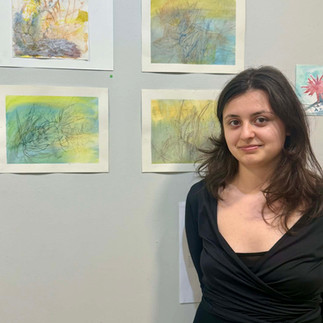
Mihaela’s work reflects a constant state of change. She embraces uncertainty and intuition, allowing her paintings to evolve naturally. Her practice resists fixed definitions, exploring identity as something fluid and open.

Although I take some starting points, I cannot oppose my own confused way of behaving. It is a confusion that I have begun to accept and grow fond of, one in which I feel comfortable. Thus, through my confusion, I operate under the illusion that I can unfold in any way I wish, that I can be anything within my paintings. I cannot, therefore, put my finger on exactly what I am, nor do I wish to do so.




.


Comments