
Maria do Carmo — Sustainable Fashion & Making with What Already Exists in Madeira

There is something very honest in the way Maria do Carmo speaks about fashion. No glamour, no illusion of endless production — just materials, people, limitations, instinct and care.
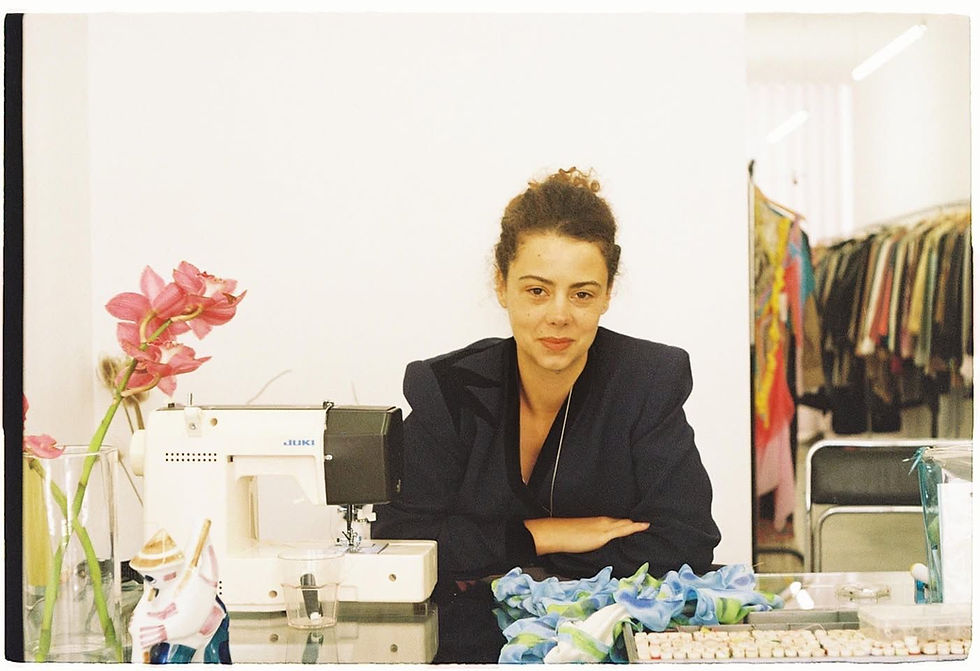
A Madeiran fashion designer and multidisciplinary artist, Maria studied womenswear at Central Saint Martins in London before returning to Madeira in 2020. Since then, her practice has moved increasingly toward upcycling, restoration and working with materials that already exist in the world.
From Fashion School to Slow Fashion
Maria says the last few years completely changed the way she thinks about fashion. After returning to Madeira and becoming an independent designer, creativity became much more connected to real life, finances and limitation.
Her work became, as she puts it, “more restricted by and more informed by my financial state than necessarily what I want and I don’t want.”
Instead of resisting those limitations, she turned toward upcycling almost instinctively. “Since there’s a lot of material already existent in the world,” she says, “it seems like a really logical choice to choose that material.”
Today, Maria works slowly, creating “one thing at a time, one piece at a time.”
She questions the pressure of seasonal fashion and constant production.
“A collection can extend throughout years,” she reflects. “We don’t have to produce something new every season.”
For Maria, sustainable fashion is not just an ecological trend — it is a different rhythm of living and creating.
After the Pandemic: Questioning the Fashion System
For Maria, the pandemic was less about productivity and more about rethinking everything. After graduation, there was still this idea that success meant entering the fashion industry, working for a brand and following the traditional system.
But slowly, she realised she was “not very interested in that,” and even questioned whether “there’s not really a necessity to keep these brands going anymore.”
Instead, the bigger question became: “How can I do what I want within my limitations?”
Interestingly, Maria does not see limitation only as something negative. In fact, she says with complete honesty: “good thing is I work very well in limitation.”
For her, restriction became less of a barrier and more of a creative method — one that pushed her toward slower, more sustainable and more personal ways of working.
Why Culture Still Matters in a Climate Crisis
For Maria, culture and ecology cannot really be separated. She believes that many traditional practices already carry forms of sustainability inside them — especially on islands like Madeira, where culture has always depended on nature, land and local resources.
“If it weren’t for culture, it would be way worse,” she says.
In her view, “all culture must work with nature,” and she even describes culture as “by definition, sustainable.”
For Maria, protecting culture also means protecting ways of living that are slower, more local and more connected to the world around us.

Can Cultural Institutions Ever Step Back?
Maria’s answer comes immediately: “I don’t think it does.”
For her, cultural institutions cannot disconnect themselves from society, because somebody still needs to protect culture, local practices and community values — especially at a moment when economics and profit often dominate everything else.
Without that protection, she says, smaller cultural voices can easily get “bulldozered by other enterprises that have much more money.” “Somebody has to protect these things,” she says.
Sustainability Also Means Not Destroying Yourself
Maria’s answer to sustainability is surprisingly personal. For her, sustainability is not only about fabrics, recycling or production methods — it is also about protecting the person who creates.
“As an individual, I take time for myself,” she says.
“If I overwork, I’ll run myself to the ground.”
What Maria calls “a really silly idea of sustainability” actually feels refreshingly honest: sustainability applied to the self. Slowing down, resting and creating with balance become just as important as the materials themselves.
People: The Problem and the Solution
When speaking about change, Maria becomes very direct.
“While people are the cure, they are also the poison.”
For her, the biggest obstacle is often self-interest. People naturally protect their own needs first — and depending on the situation, that can either create care and collaboration or lead to exploitation.
Maria believes real change only happens when people move beyond individual gain and begin thinking collectively.
“Giving should be more like the norm,” she reflects. Collaboration matters because “if you collaborate with others, you’re gonna always have a continuation.”
At the same time, Maria recognises that ecology and culture are not always simple to balance. Some traditions or systems may be culturally important while also creating ethical or environmental tensions. Still, for her, the deeper issue almost always comes back to power and personal interest.
Reality, she says, is often “clouded by interests of a few people versus the interests of everybody else.”
Artists, Education and Telling the Truth
Maria believes artists naturally grow into an educational role — not necessarily by teaching techniques, but by teaching people how to think differently.
At the beginning, she says, art can feel personal or even selfish because the artist is focused on self-expression. But eventually, “you cannot create like in a vacuum.”
For her, art is already political because “an artist questions society and the values of society.” That is why the role of the artist is not only to create beautiful things, but also to help people question what they accept as normal.
“Art teaches you how to question what you think you know,” the responsibility of the artist is simply “to step up and tell the truth.”
When speaking about what artists still lack, Maria does not think courage is the main problem. In her eyes, many artists already have courage. What they often lack is support, resources and hope.
“You need to have optimism about possibility,” she says.
Learning Beyond Techniques
When asked what she still wants to learn, Maria does not mention one specific technique or fashion skill. Instead, she smiles and says: “I feel like I’m learning all the time.”
For her, learning happens through conversations, people, mistakes, everyday life and observation. She speaks less about mastering things and more about growing through experience.
“Everything is always here,” she reflects.
What interests her most are the things that help a person live and create better: how to care for others, how to manage finances, how to stay open, and how to keep learning from people around you.
In Maria’s world, learning is not a final destination — it is simply part of living.

What Feels Urgent Right Now?
At first, Maria says that anything truly useful tomorrow should probably still matter in five years. But very quickly, the conversation turns toward urgency — especially when speaking about Madeira.
“You need to take care of the environment, need to take care of people”
For Maria, the island is facing growing pressure from tourism, luxury development and exploitation.
“Madeira is being exploited from left, right, and center,” she reflects, worried that profit often receives more attention than local communities and the environment itself.
Even if these conversations can sometimes “get you into trouble,” Maria believes artists and communities still have a responsibility to speak openly, question systems and “do what’s right.”
Because in the end, as she says: “you have to, what else can you do?”
Closing Thoughts
What makes Maria do Carmo’s perspective so compelling is the way she connects sustainability not only with materials, but with people, rhythm, care and community. Her approach to upcycling feels ecological, personal and political at the same time — a way of creating honestly within real limitations while still questioning the systems around her.
Her work reminds us that art should not exist in isolation. It should help people question, connect, reflect — and sometimes simply pay closer attention to the world around them.


Comments