
Art That Makes Us Feel: A Conversation with Lize-Mari De Abreu
- Art Center Caravel

- Jun 4
- 3 min read
We begin a new series of conversations with artists, curators, crafters, and creative people living and working on Madeira. Through these interviews, we want to explore how contemporary creatives on the island rethink sustainability, ecology, artistic practice, and our relationship with place after years of global uncertainty and rapid change.

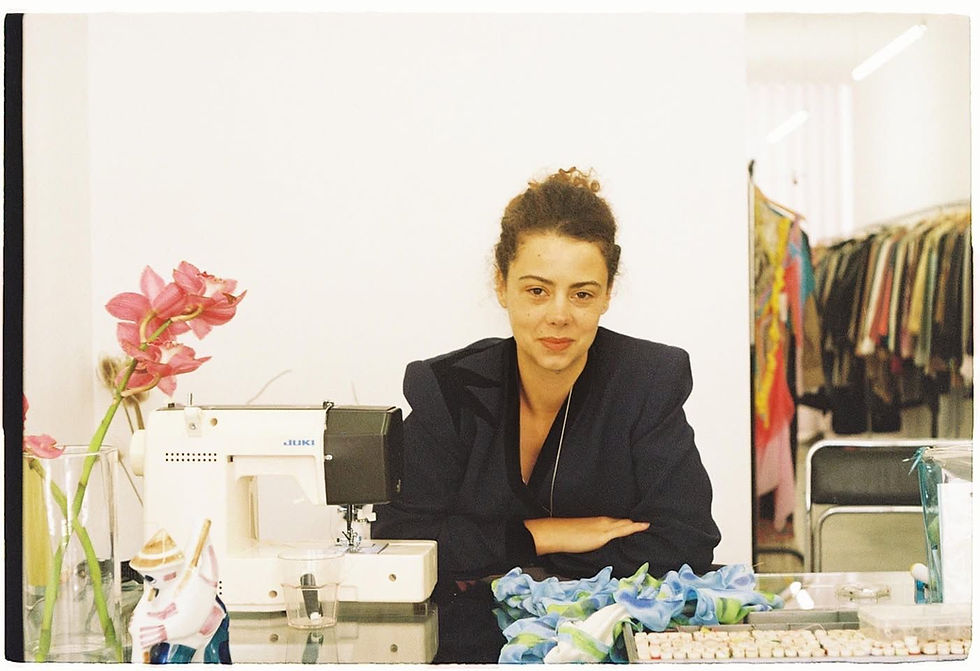
Our first conversation is with artist Lize-Mari De Abreu.
South African-born artist , now based in Funchal, Madeira, creates works that explore memory, transformation, and the emotional connection between people and place. Inspired by Madeira’s landscapes and natural beauty, her artistic practice reflects on the fragile balance between permanence and change, inviting viewers to slow down and notice the quiet details of the world around them.
In the last few years, many people started rethinking the way they live and work. How has your artistic practice changed since moving to Madeira after the pandemic?
Moving to Madeira after the pandemic, gave me space both physically and mentally to work at a larger scale and space. The pandemic forced reflection.
I stopped producing for momentum’s sake and started producing more memorable pieces and making more considered work.
Madeira is reflected through my eyes and my hard work.
When we talk about climate change, we often hear scientific facts and statistics. But what role can art and culture play in helping people actually feel connected to nature and understand what is worth protecting?
Science and activists explained the crisis but culture makes it feelable. Behavior rarely changes through data alone it changes through the work we imagine as possible.
What is beautiful and what is worth protecting, that’s where art lives, I have great reminders of natural beauty around me every day. I hope it inspires people to slow down, to take it in and hopefully still have a desire to preserve it.


Lize-Mari De Abreu. Artwork created for the 2016 exhibition and awareness campaign developed in collaboration with the AIDS Foundation South Africa, confronting stigma, memory, and social perception through art.
Sometimes sustainability already exists naturally in the way artists work, even without using the word itself. Are there parts of your creative process that already feel sustainable to you?
I draw on paper and paper is one of the lowest footprints of any art founds there is, it’s recyclable and my offcuts become studies doodles.
I use both sides of the paper to do a few portraits or to plan my next illustration. Furthermore, I don’t keep inventory that I would throw away later, but none of this was really a strategy it’s just a medium, it’s the nature of paper, right ?
What do you think is the biggest difficulty artists face today when trying to work in a more sustainable way, especially on an island like Madeira?
Then there is cost and availability. Sustainable materials are often more expensive and difficult to source, especially on an island. And the art world still rewards constant travel, frequent fees and heavy shipping.
Today artists are often expected to educate, inspire, and speak about social issues. Do you think artists should also take on an educational role?
Some are but I feel some shouldn’t be, not every artist’s job is to teach. Some ask questions that they then answer, or they provoke questions and others. Education works best when it comes from a genuine practice, instead of it being assigned as a role.
After the fast pace of recent years, many people are trying to slow down and reconnect with themselves and their surroundings. What feels most important for you to learn or hold onto right now?
For me it is the process of embracing what I’m learning and that is to slow down. Coming from a big city and moving to Madeira for me has really opened that mindset and is something that I would like to maintain and not lose as we reenter after the pandemic: the pace of the world again.
For me stillness is a gift.

Interview with artist Luiz-Mari De Abreu by Morgane Kammerer
Created within the framework of the Erasmus+ project Art for Earth





Comments